


- Advocates urge Gov. Gretchen Whitmer to grant clemency for Krystal Clark
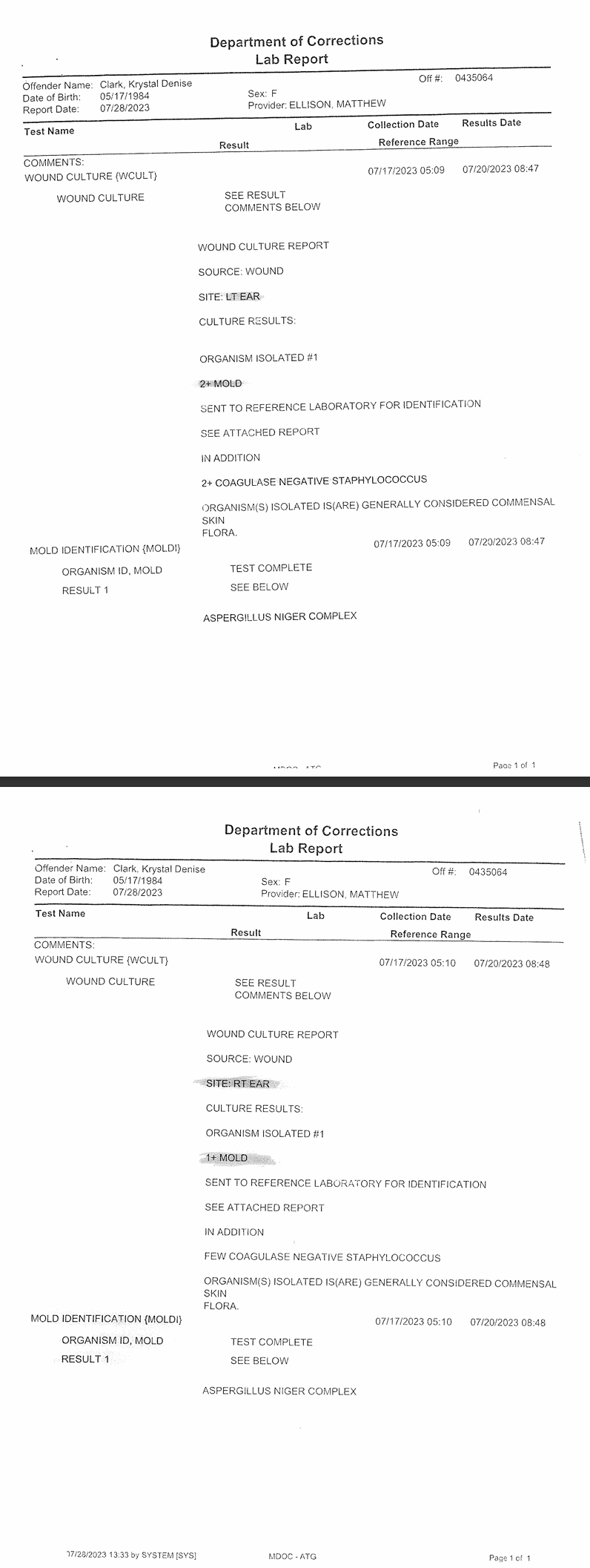
- Clark tested positive for several bacteria linked to black mold
- Former staff and inmates describe widespread mold and unsafe conditions, which the MDOC says is not true
Advocates and lawmakers are pressing Gov. Gretchen Whitmer to grant clemency to a woman they say is suffering from severe medical conditions tied to mold exposure inside Michigan’s only women’s prison.
At a Friday morning press conference, speakers pointed to mounting allegations of hazardous conditions at the Women’s Huron Valley Correctional Facility in Ypsilanti, Washtenaw County, arguing that the case of Krystal Clark reflects broader systemic failures in medical care and facility oversight within the state’s corrections system.
“They try to act like the back of my ears was growing something else … due to post-traumatic stress disorder,” Clark said in a video that was played during the press conference. “The mold in the facility is affecting me every day.”
State Rep. Laurie Pohutsky, D-Livonia, visited Clark on Feb. 12, and testified before the House Oversight Committee later that month that she saw a black, fuzzy growth coming out of and around both of her ears. She also said that Clark has a white mass across her face and that “her entire right arm, from the point where her sleeve ended, to the tips of her fingers, was incredibly swollen.”
Clark has been incarcerated at the Women’s Huron Valley Correctional Facility since 2011 and was sentenced to 17-30 years for armed robbery, assault with intent to do great bodily harm, 2nd-degree home invasion and other related charges.
She will be eligible for parole after May 9, 2027.
Related:
- Mold, medical failures alleged at Michigan women’s prison
- Longer sentences push Michigan prisons closer to capacity
- Michigan launches ‘safe prisons’ initiative amid growing assaults, concerns
“We are here not just to raise awareness. We are here to demand accountability. We are here to ask a direct question to the governor, ‘what will you do?’,” said Jay Love, Clark’s spokesperson, during the press conference. “This is a test (of) accountability and this is a test of whether the state would take responsibility for the people in its custody.”
While the state parole board reviews applications and makes recommendations, Whitmer has the constitutional authority to grant clemency, including pardons and commutations.
The Governor’s office could not provide a comment for this story because the parole board is currently reviewing Clark’s case, a spokesperson told Bridge Michigan.
State lawmakers and advocates alleged that inmates at the Ypsilanti facility suffer from health issues directly stemming from unsafe living conditions. A recent report from the Michigan Department of Corrections documented multiple air circulation devices in need of replacement.
That report, along with some other reports that were previously available, appeared to no longer be on the MDOC’s website as of Friday afternoon.
Conditions at the facility have been under scrutiny after 54-year-old Jennifer Jean Wallace died of sepsis in November from a Haemophilus bacterial infection while in MDOC custody. It was later revealed that Wallace received the wrong medication and her medical care was delayed.

Clark first made a formal complaint about the mold in 2016 and repeatedly did so during medical visits. Her medical record, which Bridge Michigan obtained from her spokesperson, indicates that she tested positive for Aspergillus niger, a common black mold typically found in moist, damp areas, in July of 2023. She also tested positive for S.marcenses, Klebsiella, and Haemophilus, bacteria all linked to exposure to black mold.
She didn’t receive treatment until August of 2025 and experienced gaps in treatment, according to Pohutsky’s testimony before the House Oversight Committee. And she didn’t receive full-dose therapy until November of 2025. She was ordered to see an infectious disease specialist on Jan. 19 but did not see one until February 17, a week before Pohutsky’s testimony.
Pohutsky said that when she visited the women’s correctional facility on Feb. 12, she also saw black spots in the seams of the shower. When asked about the spots, Pohutsky said, the warden told her that it was black paint on clear grout — not mold — and offered to eat it in front of her to prove it was not toxic.
State Rep. Dylan Wegela, D-Garden City, said that he also saw black spots in the shower seams and in a recreation room at the facility when he visited on March 13.
“Every single person who is incarcerated at the facility that I spoke to talked about the mold issues … and that those incarcerated have been asked and reportedly forced to clean and paint over the mold daily,” Wegela said during the Friday morning press conference.
Wegela said during his four-hour visit to the facility that staff told him that they saw mold as well.
Laresha Thornton, a former teacher’s aide at the women’s prison, said during the February House Oversight Committee hearing that she had been diagnosed with a chronic inflammatory disease linked to conditions at the facility.
“I didn’t realize (that) the mold had affected me,” she previously told lawmakers. “I was hospitalized and told that my intestines were swollen because of the mold.”
The Huron Valley Correctional Facility is the state’s only prison for women. As of January, about 1,800 women were held in the facility. A group of inmates sued the state last year over mold claims.
Michigan Department of Corrections spokesperson Jenni Riehle said the agency recently hired a third-party contractor to conduct additional environmental testing at Huron Valley Correctional Facility. She said the results aligned with “typical findings for large, occupied facilities” and disputed claims of widespread or hazardous mold conditions.
“The department takes the health and safety of those currently under our supervision very seriously, and we remain committed to being a transparent partner,” Riehle said. “We appreciate our officers, health care employees, and all other hard-working MDOC staff for their dedication to our core missions of public safety and preparing people for success.”
More broadly, advocates are calling for 800 women in the facility to be released over 3 years due to the conditions within the prison.
“Until they make room for healing and start allowing women to be released while they are still able to give back to the community with their skills and talents instead of (taking) from the community through incarceration, the problems will remain,” said LaWanda Hollister, organizer of the American Friends Service Committee, in an open letter to state leaders. “I know these women and they are rehabilitated and need the opportunity to come home and demonstrate their rehabilitation.”






You must be logged in to post a comment.