


- Lake Erie reaches 95% ice cover after cold snap, other Great Lakes exceeding ice cover averages
- The freeze marks a sharp contrast from recent low-ice winters
- Warming temperatures are expected to gradually melt lake ice
Lake Erie is covered nearly shore-to-shore in ice, and more than half of Lake Superior is frozen over too, winter milestones that have become increasingly rare as milder seasons reshape the Great Lakes.
For the first time in decades, Lake Erie is nearly completely frozen. As of Sunday, about 95% of the lake is covered in ice, according to the National Oceanic and Atmospheric Administration.
The last time Lake Erie was as frozen was in 2015, when ice coverage also reached about 95%. It last froze over completely in 1996, a feat that may not be matched as temperatures rise this week. Satellite imagery from Sunday appeared to show a large crack forming in the ice.
The expansive ice cover marks a sharp turnaround from just a month earlier, when only about 21% of Lake Erie was iced over. It also stands out after several winters with minimal ice coverage.
Last year, about 88% of the lake froze. In 2024, ice cover peaked at just under 4%, and in 2023, about 14% of the lake froze.
Related:
- Feds take another step toward decision on Line 5 tunnel
- Scientists trying to solve mystery of ‘rock snot’ in Michigan streams
- PFAS levels are declining in Great Lakes fish, new research shows
“When you get colder stretches that are well below 32 degrees, it can quickly add to the ice coverage on the lake,” said Andrew Arnold, meteorologist for the National Weather Service’s Detroit office. “Usually when you get those compounding days, that’s when you get pretty good conditions for (water) to ice up pretty quickly on that lake.“
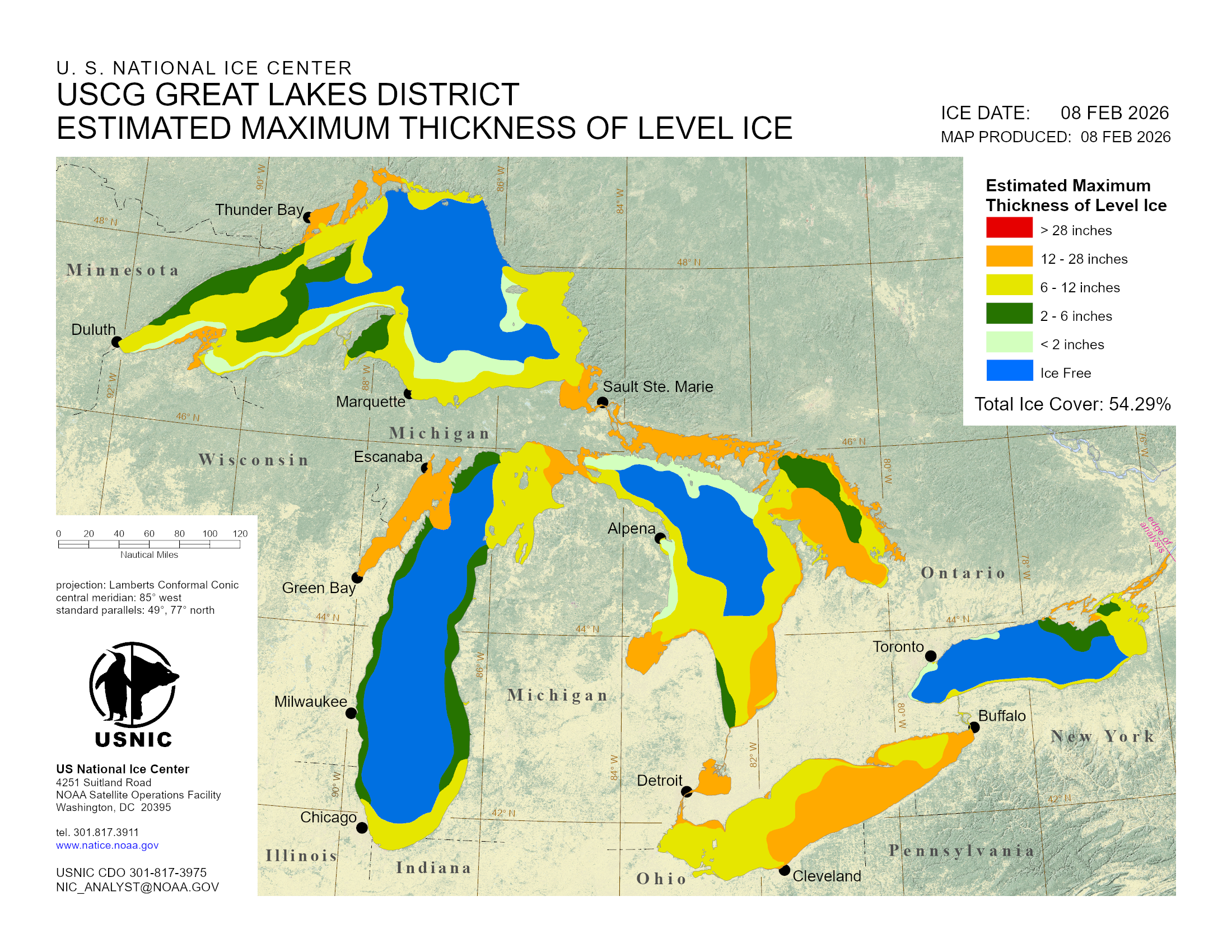
Ice coverage across the rest of the Great Lakes varies. As of Feb. 9, Lake Superior was about 51% frozen, Lake Michigan 34%, Lake Huron 67% and Lake Ontario 26%.

In some areas, including near the Detroit River, the ice on Lake Erie was between 12 and 28 inches thick as of Sunday, according to the US National Ice Center. That was also true on Lake Huron near the Thumb, the Straits of Mackinac, on Lake Michigan near Escanaba and on parts of Lake Superior.
While recent cold snaps accelerated the freeze, Arnold said Lake Erie icing over this time of year is not unusual.
“It is very shallow compared to the other lakes so that’s why it does end up freezing, or at least the majority of it, over the course of the winter season,” Arnold said. “I wouldn’t call it abnormal for what we’re seeing currently, other than just it peaked a little bit earlier than the historical average.”
Typically, Lake Erie reaches peak ice coverage during mid-to-late February.
The colder conditions are being driven by a mix of factors, including the return of La Niña, a climate pattern that can shift the jet stream and bring colder, stormier weather to the region.
The NOAA’s seasonal outlook shows an equal chance of above-average or below-average temperatures across the state from February through April.
As winter begins to loosen its grip, forecasters say the lake’s ice cover is unlikely to last at peak levels for long.
Temperatures will start to warm up on Tuesday when the high will reach 43 degrees in metro Detroit and then cool back down on Wednesday to 32 degrees, according to The Weather Channel. Temperatures will rise again throughout the rest of the week, reaching 38 degrees by Saturday.
“When you get a lot of non-cloudy days where you’re able to get a lot of sun that’s able to hit the ice, that combined with warmer temperatures that are above freezing, that’s usually when you start to get pretty decent melting,” Arnold said.
Nearby Lake St. Clair has also seen major ice accumulation. It completely froze over on Jan. 27 and has maintained 100% ice cover 11 of the past 13 days, according to NOAA.
That prompted large crowds as cars, dirt bikes and snowmobiles raced across Lake St. Clair. Recently, a Lamborghini was spotted spinning donuts on it.
Thank you to our Michigan Environment Watch sponsors



Bridge Michigan Environment Watch is made possible by generous financial support from our sponsors. Sponsorship supports our independent journalism mission but does not constitute sponsor endorsement of individual articles or editorial content. Bridge Michigan journalism remains fact- and data-driven and independent at all times.
Please visit the About page for more information and to subscribe to Environment Watch. Interested in becoming a sponsor? Contact Emma Carr.






You must be logged in to post a comment.