


- Trump’s team helped broker a Gaza ceasefire pushed new Ukraine talks and deployed troops in US cities
- Sweeping tariffs boosted revenue and sparked new auto investments but inflation has started to rise
- Trump’s first nine months in office have been cheered by supporters but sparked protests across Michigan, country
Wars abroad and military deployments at home have dominated President Donald Trump’s last three months as he continues to earn praise from his supporters while angering critics, many of whom took to the streets last weekend with protests in Michigan and other states.
The Trump administration has been busy, checking off a controversial to-do list, including economic and immigration policy promises made in Michigan during the campaign. He’s also taken actions he did not campaign on, like sending troops into US cities, limiting vaccine research and vaccine access, indicting or investigating opponents, encroaching press freedoms and cutting or declining to spend billions authorized by Congress.
In an October 2024 stop in Hamtramck, Trump vowed that if elected, he’d secure a Middle East peace deal. This month, his administration played a central role in a cease-fire agreement that could end the war in Gaza.
Trump’s influence helped stop Israeli attacks on Gaza, which followed terror attacks on Israel in October 2023, and led to the release of the remaining Israeli hostages and some Palestinian prisoners.
Yet Trump has also sent National Guard troops into several US cities, all run by Democrats, saying they’re needed to bring down crime and violent attacks. Trump has justified the deployments using rhetoric — quelling “rebellion against the authority of the government” — that some federal judges say doesn’t match the reality in those cities.
Related:
- Trump gets his ‘big, beautiful bill.’ What it means for Michigan
- Michigan rural hospitals at risk under Trump’s ‘beautiful’ bill, experts say
- Trump promised a ‘Michigan miracle.’ Now comes the hard part
On the economic front, the economy has shown signs of wobbling, though jobless rates are the same now as a year ago, both in Michigan and the nation. Inflation, which Trump repeatedly said he’d bring down, has ticked up, though not as much as economists expected because of tariffs.
Some of the best data on jobs has been delayed by the current federal shutdown. Trump also fired a top economic official in August after a poor jobs report came out, citing without evidence that the numbers were altered to hurt him. He called prior jobs numbers “phony” and claimed they were “rigged in order to make the Republicans, and ME, look bad.”
Subsequent data releases confirmed job growth statistics were overstated, showing slower growth than initially reported.
Bridge Michigan is periodically reviewing the president’s follow-through on the more than 100 promises he made to voters in the state during his winning 2024 campaign. Here is where things stand nine months since Trump took office.
Peace and security
Promise: “We’re going to get peace in the Middle East,” Trump said last fall during a brief campaign stop in Hamtramck. The call resonated with many Arab Americans in Michigan who were upset with the Biden administration’s staunch support for Israel in the Gaza conflict. Trump ended up winning a majority of votes in Dearborn and Dearborn Heights, both home to substantial numbers of voters of Arab descent. He also said he’d “end the war in Ukraine” during a stop in Grand Rapids.
Actions: Trump administration negotiators, including his former business partner Steve Witkoff and his son-in-law Jared Kushner, pressed Israel, Hamas and Arab states to end the war in Gaza, with Trump backing a deal. Earlier this month, Trump announced there was a cease-fire deal and Hamas has already released the remaining Israeli hostages.
But the peace has been fragile: After Hamas attacked some Israeli positions, Israel’s military struck back over the weekend.
As for Ukraine, Trump in August held a summit with Russian President Vladimir Putin in Alaska. It did not end with an agreement. Another direct Trump-Putin meeting was planned in Budapest but canceled Tuesday amid long-standing differences on how to resolve the conflict. He most recently met with Ukrainian President Volodymyr Zelensky on Friday.

Results: Regarding Gaza, a territory about the size of Detroit, more agreements have to be hammered out, but the tentative deal reached earlier this month has brought applause from both Trump supporters and critics who approve of the president’s role in ending a two-year war. Nearly 68,000 Gaza residents — including many civilians — have been killed. The Israeli attacks began after Hamas, the terrorist group running the territory, attacked Israel on Oct. 7, 2023, killing 1,200 Israelis and taking 251 hostages. But Palestinian peace plans haven’t lasted in the past, and Hamas has yet to agree to lay down its weapons, one of the key provisions of Trump’s plan.
The situation in Ukraine remains far more unsettled, and the war continues. After months of appearing to favor Putin’s position, Trump started showing more support for Ukraine. In August he said that any deal would require Ukraine to cede territory but he reversed himself in September and suggested Ukraine could be able to win back all of its lost territory. Over the weekend, however, he appeared to side, again, with Russia, saying the fighting should stop where the current battle lines are. Russian forces are currently in substantial portions of eastern Ukraine.
Trump has also floated the idea of giving Ukraine long-range Tomahawk cruise missiles, a weapon that would allow Ukraine to strike Moscow and far beyond, before pulling that idea back.

Economy, tariffs and inflation
Promise: Trump centered his pitch to Michigan voters around restoring auto jobs and the industry that led the state to economic heights unseen since the 1970s. He promised huge tariffs to push manufacturers to bring jobs back to the US. He attacked the electric vehicle industry and said he’d end EV subsidies.
He also said inflation would fall quickly.
“We will quickly defeat it. We have to bring down prices. I will cut taxes, slash regulations, curb wasteful spending, and unleash energy production. It’ll all happen very quickly,” Trump said Oct. 10 in Detroit. “This will rapidly drive prices down, lower interest rates, and put more money into the pockets of American consumers.”
Actions: Trump enacted sweeping tariffs on countries across the globe, cutting deals with some countries to keep them lower — but still higher than before he took office. The “big, beautiful” bill approved by Congress ended the $7,500 tax credit for new EV purchases. As for inflation, the Trump administration has targeted pharmaceutical companies for steep tariffs to force some agreements that could save consumers hundreds of millions of dollars.
Results: Unemployment in Michigan, at 5.2% in August, is the same as when Trump was elected. Inflation in August was clocked at 2.9% over the past year, down from 3% in January but up since it was at 2.4% in March. Economists had predicted that importers would pass on the tariffs in the form of higher prices and that has occurred for some goods. But importers have also absorbed billions in tariff costs so far. The tariffs generated nearly $30 billion in new federal revenue in August and nearly $200 billion for the year.
In the auto sector, Michigan’s dominant industry, the results are mixed. GM recently announced it has lost $1.6 billion this year in costs dedicated to electric vehicle production. Ford has paused construction of an EV plant in Tennessee.
But in addition to earlier announcements of plans to bring more production capacity into the US:
- Stellantis last week announced plans to invest $13 billion in US production facilities, including $230 million for plants in Detroit and Warren, where 900 jobs will be added, and $400 million for the Jeep complex in Toledo, just south of the state border with Ohio.
- GM announced in June it was spending $4 billion on plants in Michigan, Kansas and Tennessee to build more gas and electric vehicles.
- Ford announced in August it too was investing in US facilities — $5 billion to add capacity and jobs in Michigan and Kentucky.
In relation to the tariffs’ impact on other industries, prices have risen on some goods. The cost of coffee, for instance, is up nearly 10% from April to August. Jewelry is up nearly 5%, bananas 4.9% and TVs 3%.
As for pharmaceuticals, Pfizer and AstraZeneca have reached agreements with the administration on lower drug costs, and the US Department of Health and Human Services has been charged to pursue lower costs with drug providers.
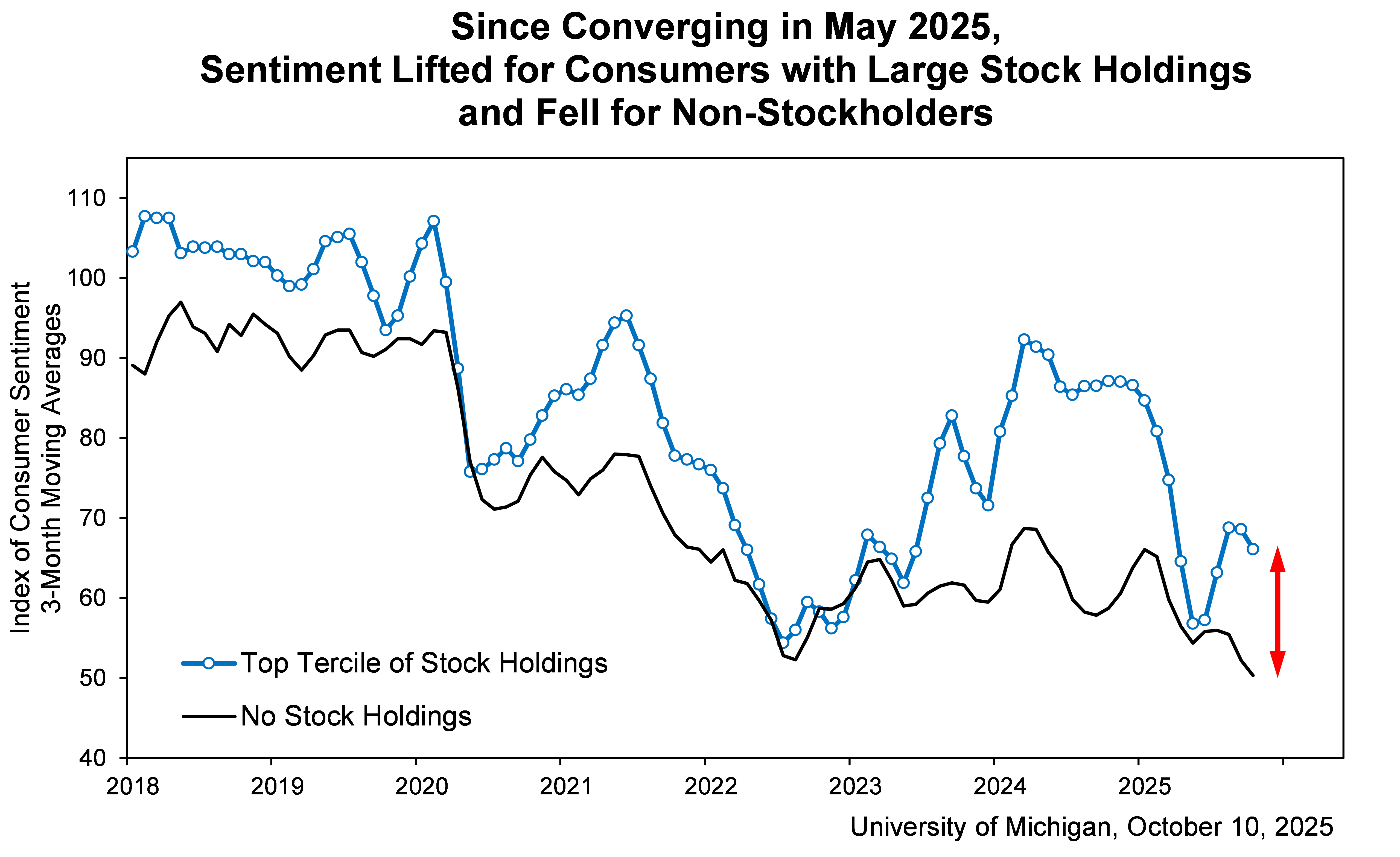
Economically, the biggest winners so far have been investors.
The stock markets have continued their roller coaster ride since the election, but are substantially higher now. As of Tuesday, the Dow Jones Industrial average stood at 12% above Election Day levels and the S&P 500 was up 18%. The Russell 2000, a larger and broader stock index, is up 12%, most of that in the last three months. Experts say an explosion of spending on artificial intelligence — billions for data centers, computer chips and AI partnerships in sectors like retail — is turbocharging the markets. But some prominent voices worry the nascent tech has created an investment bubble that could pop.
The jump in stock prices, however, has revealed how the US population is not sharing equally in the rise. According to researchers at the University of Michigan, who have tracked consumer confidence for decades, those who do not have investments in the stock market — roughly one-quarter of all households do not — have a far gloomier view of the economy than those who do.
Crime
Promise: In repeated campaign stops Trump said his administration would tackle crime. “We’re going to stop the crime. We have to let people feel free and be able to walk outside and not even think about being mugged or hit or shot or anything,” he told a Detroit audience and in Warren in November he said he’d “crush violent crime and give our police the support, protection, resources, and respect that they so dearly deserve.”
Actions: Trump has not taken direct steps to reduce crime in Michigan and in May cut $4.5 million in criminal justice grants for organizations that work to reduce gun violence in Detroit and Lansing.
Elsewhere, he deployed the National Guard to patrol Washington DC to reduce crime, and later sent troops to Memphis, Chicago, Los Angeles while trying to put them in Portland — aggressive steps he did not hint at during his August 2024 speech to the National Guard Association in Detroit.
In September, Vice President JD Vance said Trump would send National Guard troops to Detroit if Gov. Gretchen Whitmer asks. That’s “unwarranted,” Whitmer said in response.

Results: Crime rates in Michigan were down in 2024, before Trump took office, according to reports, driven by big declines in Detroit, Muskegon and Flint. Statewide data for 2025 is not yet available to assess whether crime has continued to fall under Trump.
Though down, Detroit crime rates remain substantially higher than the rest of the state, and it is one of the more violent large cities in the US. There were 31 murders for every 100,000 people in 2024. That was significantly lower than the 45-50 per 100,000 in previous years, but still six times higher than the national rate of 5 per 100,000.
Homicides are so far down again this year in Detroit, according to Mayor Mike Duggan. Shootings and carjackings are down again so far this year, the city told Bridge Michigan.
End ‘weaponization’ of legal system
Promise: In a February stop in Waterford Township, Trump returned to one of his most consistent critiques — of the US justice system. He was indicted in multiple state and federal jurisdictions over his personal business, his handling of classified documents and his role during the Jan. 6, 2020, riot at the US Capitol as lawmakers were confirming Joe Biden as president.
He has denied wrongdoing and said he was a victim of “witch hunts” by his opponents. In his Michigan stop, he said his highest priority was “ending the weaponization of the legal system” and vowed to restore “fair, equal and impartial justice” while dismissing the charges he was facing in state and federal courts.

Actions: Trump appointed staunch allies, including some of his former personal attorneys, to top key roles in the US Attorney’s Office and the FBI. He appointed his one-time criminal defense attorney, Emil Bove, to a seat on the US Third Circuit Court of Appeals.
Results: Critics argue Trump is doing what he said he’d stop: “weaponizing” the legal system. After calling for indictments of some of his opponents, Trump fired some top attorneys who had declined to press charges against former FBI head James Comey and Letitia James, a former New York attorney general who had successfully prosecuted Trump for business fraud. Trump’s newly appointed prosecutor, Lindsey Halligan, secured Comey and James indictments and fired attorneys who had objected. Trump has also called for further investigations into political opponents, including US Sen. Adam Schiff, D-California, who led Trump’s first impeachment trial.
Electric vehicles and energy
Promises: Trump said he’d cut the subsidies for new electric vehicles and end so-called mandates on EV production. He also said he’d take steps to expand the production of fossil fuels and cut energy costs in half within a year of taking office.
Actions: As mentioned above, Trump signed the bill eliminating subsidies for EVs, and his administration has halted solar and wind projects. The administration also quickly rolled back the auto emission goals that would have accelerated the use of EV vehicles.
Results: The EV subsidies ended at the end of September. Auto experts, including Ford CEO Jim Farley, expect an immediate drop in the number of electric cars sold in the US.
Home energy costs have not fallen. In July, the average cost of residential electricity in Michigan was $20.56 cents per kilowatt-hour, up nearly 4% from a year earlier, according to the US Energy Information Administration.
In Michigan, a gallon of gas costs $2.83, down 15% from $3.34 a year ago, according to AAA. Also, the turn back toward fossil fuels was a factor in GM’s decision to add production capacity of a V8 internal combustion engine (see above).
In vitro fertilization treatments
Promise: Trump used an August campaign speech in Potterville to promise free IVF for all. “Your government will pay for, or your insurance company will be mandated to pay for, all costs” associated with the expensive procedure that allows some couples to have children, he said.
Actions: In February Trump signed an executive order to begin a review of ways to lower costs for IVF treatment. Last week, he announced a plan to cut the cost of one of the most common IVF drugs and ordered that health care providers can offer fertility insurance, like dental or vision insurance.
Results: Trump has not made IVF free for all, nor has he mandated the government or health insurers to cover the cost. His administration says the steps he has taken could save couples up to $2,200 per cycle of the procedure, which typically costs more than $10,000 per cycle in Michigan.
Immigration
Promise: Trump told Michigan audiences that he would “stop the invasion” along the border with Mexico. “On day one, I will launch the largest deportation program of criminals in American history. I will rescue every city and town that has been invaded and conquered,” he told a Grand Rapids audience hours before polls opened in November.
Actions: The administration has hired thousands of immigration officers, dispatched the military to help with border patrol and worked across the country at finding and deporting migrants. Protests at offices of Immigration and Customs Enforcement (ICE) locations have led to deployment of National Guard troops. The government has also spent millions on ads telling people to leave the country and to help recruit new ICE officers.

Results: The federal government continues to target immigrants, and attempted crossings of the southern border have cratered, from 1.24 million in the first eight months of 2024 to 135,515 this year. Raids, however, have swept up US citizens repeatedly, prompting legal challenges. Trump and Vance said their immigration crackdown would begin with criminals.
But as of September, most people arrested by Detroit’s U.S. Immigration and Customs Enforcement field office reportedly had not previously been charged with crimes.
Drugs, fentanyl
Promise: Trump repeatedly talked about going after the people trafficking drugs, including fentanyl, into the US. “We’ll bust up and dismantle the gangs, savage criminal networks, and bloodthirsty cartels. And we will stop the fentanyl,” he said during an August stop in Howell, where he met with local law enforcement.
Action: The Trump administration has gone after drug dealers, focusing first on immigration while naming cartels as “foreign terrorist organizations.” He has bolstered border security, and the “big, beautiful” bill will lead to billions of dollars in additional border security. He has directed the military to blow up six boats near Venezuela and Colombia that he said were transporting drugs. He has also directed the CIA to craft plans for potential covert action in that South American country.
Result: It’s unclear how many died in the boat attacks or whether they were transporting drugs. Critics argue the attacks cannot be justified legally.
Trump has claimed that every drug-trafficking boat that is stopped saves “25,000 lives,” a contested claim.
Deaths from opioids have fallen for a few years but still outnumber gun deaths. In 2024, the nation had 79,000 overdose deaths, including 1,800 in Michigan. Data for 2025 is not yet available.
The amount of drugs confiscated since January is up nearly 9% compared to the corresponding months in 2024 when President Joe Biden was in office.






You must be logged in to post a comment.