


- Volunteers with the nonprofit Friends of the Rouge have been monitoring amphibian calls in southeast Michigan for decades
- The data suggests four frog species may be declining in the area
- Development and climate change may be contributing factors but more research is needed
At least two times a month in most of the spring and summer, Plymouth resident Larry Martin heads out into the woods to listen.
He takes his border collie and walks without a flashlight. Once he’s within earshot of a body of water, he looks at a list of seven kinds of frogs and one toad and marks which ones he hears.
Martin is one of hundreds of volunteers who track the frog and toad population each year in the more than 450 square miles of the Rouge River watershed in southeast Michigan. The nonprofit Friends of the Rouge started the project in 1998 as a way to assess wildlife habitat in what has been deemed an area of concern — somewhere degraded and harmed by human activity — by the US Environmental Protection Agency.
Now, with decades of data, the nonprofit says four frog species seem to be declining in numbers, while the American toad and three other species of frogs appear to be increasing.
“Any drastic change in amphibian species and occurrences is concerning for the state of our ecological system,” said Sam Davis, monitoring coordinator with Friends of the Rouge. “Everything is in a very fine balance.”
RELATED:
- Vernal pools hold hundreds of creatures. But how many exist in Michigan?
- Think you’re getting old? New study says Michigan sturgeon may live to 400
- Iconic whitefish on edge of collapse as Great Lakes biodiversity crisis deepens
Friends of the Rouge officials say that, in order to draw conclusions about what’s going on with amphibians, more research is needed.
“(We) are pointing to patterns that our analysis is showing as the first step to understanding the larger implications for the watershed,” Davis wrote in an email to Bridge Michigan.
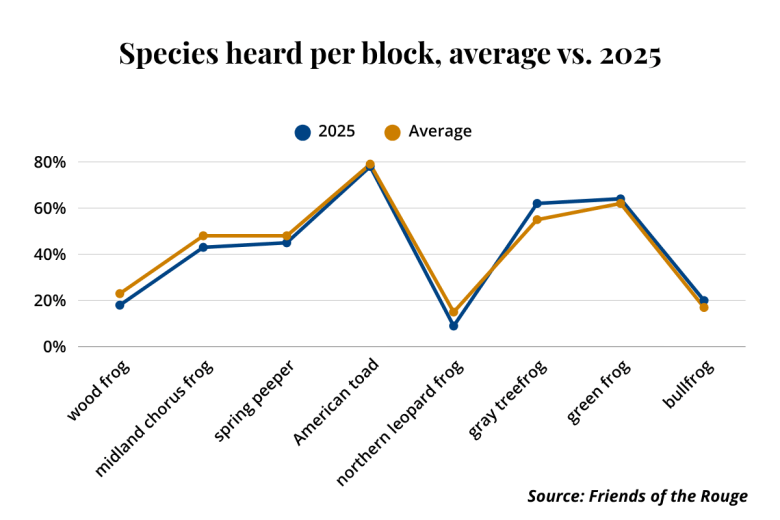
Where the volunteers go to monitor for frog and toad calls varies year to year slightly depending on the number of volunteers participating and where they live, so the data pool isn’t perfect. But trend lines showthe percentage of quarter-square-mile “blocks” — or survey areas —where wood frogs, midland chorus frogs, northern leopard frogs and spring peepers were heard is going down, particularly for spring peepers. Trend lines for the percentage of blocks where American toads, gray treefrogs, greenfrogs and bullfrogs were heard are going up, particularly for the gray treefrog.
Davis said the nonprofit isn’t researching why call changes may be occurring but a general increase in development could be displacing habitat, while some habitat is growing. Extreme weather variation exacerbated by climate change could also be a factor.
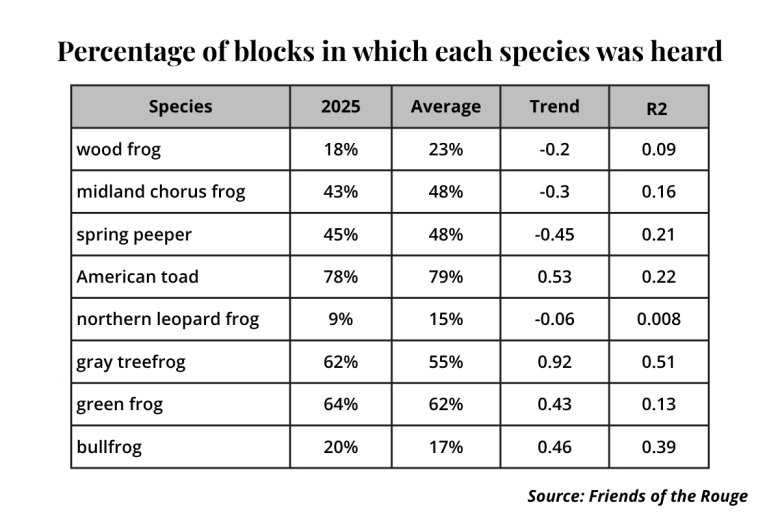
The amphibians studied are divided into two categories, those that begin calling earlier in the year and those that begin calling later in the year.
Of the species that appear to be declining, most are earlier callers, while most of the species that appear to be increasing are late callers. Davis said the past several winter seasons have had extreme temperature fluctuations, which “are very, very taxing on these early calling species.”
The call of duty
Volunteers for the project are trained on how to recognize the frog and toad calls before they go out in the field and are given a test to prove proficiency. Still, it can be a little difficult to distinguish calls sometimes, especially when more than one species is making noise.
To deal with this issue, Davis said a volunteer developed a Web tool called Froggy Voice that plays each frog and toad call alone and in conjunction with other calls. It can be a helpful tool in the field.

Martin is pretty good at recognizing the calls after being involved for five years and surveying multiple areas each year. This year, he monitors 14 spots.
“I love being outside, especially at the change of the day, in either the night to morning or the day to night, because that’s when the wildlife in general is most active,” he said.
Sign up for our outdoors newsletter
Want more coverage like this delivered directly into your inbox? Sign up for the Bridge Michigan Outdoors newsletter here.
And he’s had some encounters.
“You’d be surprised how close you can get to the deer at night if you’re just walking through the woods without a light,” he said. “I’ve been startled by deer snorting at me.”
Some people ask him if it’s scary going out into the woods at night, but he says it’s not. He hasn’t seen any danger. But he said that, for hesitant volunteers, there are some areas where you can listen from your car.
Friends of the Rouge is always seeking additional volunteers for the project.
“Folks who live or are frequently around our watershed, we would love to have them,” Davis said.
Sign-ups will be posted on the Friends of the Rouge website, Davis said, and will likely open up in December.
Thank you to our Bridge Michigan Outdoors sponsors



Bridge Michigan Outdoors is made possible by generous financial support from our sponsors. Sponsorship supports our independent journalism mission but does not constitute sponsor endorsement of individual articles or editorial content. Bridge Michigan journalism remains fact- and data-driven and independent at all times.
Please visit the About page for more information and to subscribe to Bridge Michigan Outdoors. Interested in becoming a sponsor? Contact Emma Carr.






You must be logged in to post a comment.